
Manufacturing businesses today operate in a highly competitive environment where timely decisions can significantly impact productivity, profitability, and customer satisfaction. Small and medium-sized enterprises (SMEs) often struggle with fragmented data spread across production, inventory, purchasing, and finance, making it difficult to gain a complete view of operations.
This is where SAP Business One becomes a powerful solution. It provides manufacturers with real-time reporting capabilities that help monitor every stage of the production cycle—from raw material procurement to finished goods delivery. Instead of relying on spreadsheets or manual reports, SMEs can access accurate, up-to-date information to make informed business decisions.
At MegatechVerse, we help manufacturing businesses implement SAP Business One to streamline operations and generate meaningful reports that improve efficiency, reduce costs, and support sustainable growth.
Why Manufacturing Reports Matter for SMEs
Manufacturing reports provide valuable insights into production performance, inventory levels, material consumption, machine utilization, and overall operational efficiency. These reports help business owners identify bottlenecks, optimize resources, reduce waste, and improve customer service.
With SAP Business One, all manufacturing data is stored in a centralized system, ensuring reports are accurate, consistent, and available in real time.
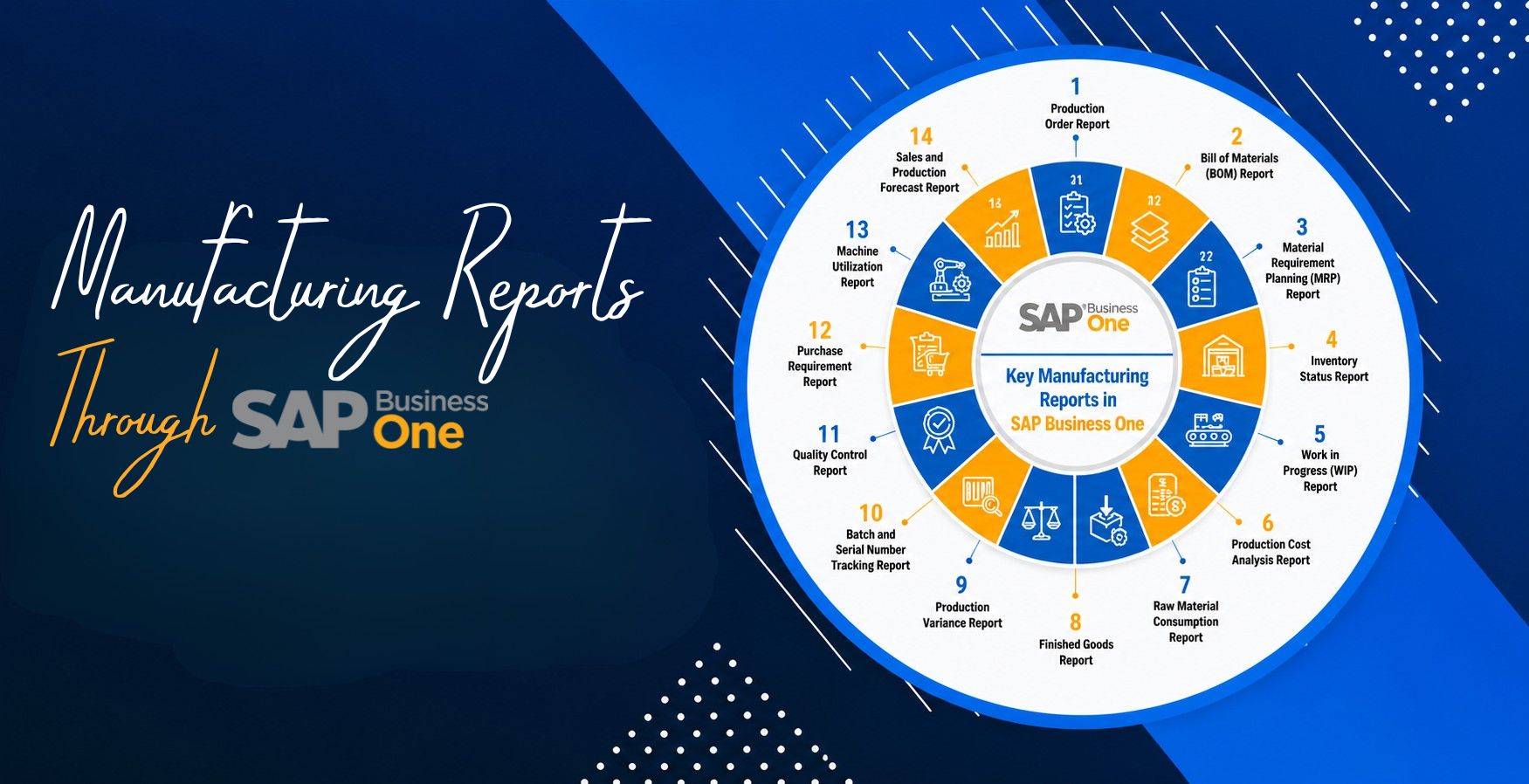
Key Manufacturing Reports Available in SAP Business One
1. Production Order Report
The Production Order Report provides a complete overview of all production orders, including planned, released, completed, and closed orders. It gives production managers real-time visibility into manufacturing progress, helping them monitor workflows, identify delays, and ensure production targets are met on schedule.
This report enables manufacturers to:
- Monitor production progress by tracking every stage of manufacturing from order release to completion.
- Track order completion status to know which production orders are pending, active, or completed.
- Identify production delays early and take corrective action before they affect customer deliveries.
- Improve production scheduling through better allocation of manpower, machinery, and resources.
- Analyze manufacturing efficiency to identify performance gaps and optimize production processes.
Managers can quickly determine which production orders require immediate attention and allocate resources accordingly.
2. Bill of Materials (BOM) Report
The Bill of Materials (BOM) Report lists all raw materials, semi-finished goods, and components required to manufacture a product. It serves as the foundation of every production process by ensuring that the correct materials are available in the required quantities.
Benefits include:
- Accurate material planning that ensures production starts without material shortages.
- Reduced production errors by using standardized product structures.
- Better cost estimation through accurate calculation of material requirements.
- Easier product revisions whenever engineering or design changes occur.
- Improved inventory planning by maintaining the right stock levels for manufacturing.
A well-maintained BOM ensures every production order uses the correct materials in the required quantities.
3. Material Requirement Planning (MRP) Report
The MRP Report helps manufacturers determine future material requirements based on customer demand, inventory levels, and production schedules. It supports smarter purchasing decisions while preventing production interruptions.
It assists businesses in:
- Planning raw material purchases according to future production demand.
- Preventing stock shortages that can delay manufacturing activities.
- Reducing excess inventory and lowering inventory carrying costs.
- Improving procurement efficiency by generating purchase recommendations automatically.
- Supporting just-in-time manufacturing through accurate material planning.
For SMEs, this report minimizes working capital tied up in unnecessary inventory.
4. Inventory Status Report
Inventory plays a crucial role in manufacturing operations. The Inventory Status Report provides real-time visibility into stock availability across warehouses, allowing businesses to make informed inventory decisions.
The report includes:
- Current stock levels for every inventory item.
- Reserved quantities already allocated for existing production or sales orders.
- Available inventory ready for immediate production or customer delivery.
- Warehouse-wise stock to monitor inventory across multiple locations.
- Item valuation for accurate financial reporting and inventory control.
This enables manufacturers to avoid production interruptions caused by material shortages.
5. Work in Progress (WIP) Report
The Work in Progress Report tracks products that are currently being manufactured but are not yet completed. It helps businesses understand the status of unfinished production and the costs involved.
It helps businesses:
- Monitor ongoing production across different manufacturing stages.
- Measure production costs associated with unfinished goods.
- Track unfinished goods awaiting completion.
- Analyze manufacturing efficiency during active production.
- Improve production planning by monitoring production progress in real time.
The WIP report provides better financial visibility into production activities.
6. Production Cost Analysis Report
Understanding manufacturing costs is essential for profitability. The Production Cost Analysis Report provides a detailed breakdown of manufacturing expenses, helping businesses compare planned costs with actual production expenses.
This report provides detailed information on:
- Material costs associated with raw materials and components.
- Labor costs incurred during manufacturing.
- Machine costs related to equipment usage.
- Overhead expenses such as utilities and indirect production costs.
- Actual vs planned production costs to identify cost overruns.
SMEs can identify cost overruns and implement corrective measures to improve margins.
7. Raw Material Consumption Report
This report tracks the quantity of raw materials consumed during production. It helps manufacturers understand how efficiently materials are utilized and identify opportunities to reduce waste.
It helps manufacturers:
- Compare planned vs actual consumption to detect usage differences.
- Detect material wastage during production.
- Improve inventory accuracy through better stock reconciliation.
- Control manufacturing costs by reducing unnecessary consumption.
- Optimize production processes using material consumption insights.
Businesses can quickly identify areas where material usage exceeds expectations.
8. Finished Goods Report
The Finished Goods Report provides details about products completed during a specific period. It supports inventory management and ensures finished products are available to meet customer demand.
The report includes:
- Product quantity manufactured during the reporting period.
- Production date for every finished item.
- Warehouse location where products are stored.
- Batch information for complete traceability.
- Product availability for order fulfillment.
This information supports sales planning and order fulfillment.
9. Production Variance Report
Production rarely follows the exact planned schedule or budget. The Production Variance Report compares planned production with actual performance, helping businesses identify operational inefficiencies.
It measures:
- Quantity variance between planned and actual production output.
- Cost variance to identify budget deviations.
- Time variance caused by production delays.
- Material variance resulting from unexpected consumption.
- Labor variance based on workforce productivity.
Manufacturers can identify inefficiencies and continuously improve production processes.
10. Batch and Serial Number Tracking Report
For industries such as pharmaceuticals, food processing, electronics, and chemicals, batch traceability is essential. SAP Business One enables complete tracking of every product throughout the supply chain.
SAP Business One allows manufacturers to generate reports showing:
- Batch numbers for product traceability.
- Serial numbers for individual product identification.
- Manufacturing dates for production history.
- Expiry dates where applicable.
- Supplier information for raw material tracking.
- Customer delivery details for faster product recalls if required.
This simplifies product recalls and ensures regulatory compliance.
11. Quality Control Report
Quality is a key competitive advantage. The Quality Control Report helps manufacturers monitor product quality throughout the production process and reduce manufacturing defects.
The Quality Control Report enables manufacturers to monitor:
- Inspection results from quality testing.
- Rejected items that fail quality standards.
- Defect rates across production batches.
- Quality trends over time.
- Rework analysis to reduce repeated manufacturing errors.
Businesses can identify recurring quality issues and implement preventive measures.
12. Purchase Requirement Report
Manufacturing depends heavily on timely procurement. The Purchase Requirement Report helps procurement teams identify purchasing needs based on production schedules and inventory availability.
This report helps purchasing teams identify:
- Materials requiring replenishment before shortages occur.
- Pending purchase orders awaiting supplier delivery.
- Supplier lead times for better procurement planning.
- Purchase recommendations generated by the ERP system.
The result is better supplier coordination and uninterrupted production.
13. Machine Utilization Report
Efficient machine usage directly impacts production capacity. The Machine Utilization Report measures equipment performance and identifies opportunities to improve productivity.
This report provides information about:
- Machine operating hours during production.
- Idle time affecting productivity.
- Production efficiency achieved by each machine.
- Equipment utilization across production facilities.
- Capacity planning for future manufacturing requirements.
Manufacturers can optimize equipment performance and reduce downtime.
14. Sales and Production Forecast Report
SAP Business One combines historical sales data with production planning to generate accurate forecasts. These insights help manufacturers prepare for future customer demand with greater confidence.
This report helps businesses:
- Estimate future demand using historical sales trends.
- Plan production capacity based on expected orders.
- Optimize inventory to avoid shortages or excess stock.
- Improve procurement planning through better forecasting.
- Reduce overproduction and lower inventory costs.
Forecasting enables SMEs to respond proactively to market changes.
15. Manufacturing KPI Dashboard
In addition to standard reports, SAP Business One provides dashboards displaying key manufacturing performance indicators in real time. These dashboards allow business owners to monitor operations from a single screen and make informed decisions quickly.
Common KPIs include:
- Production efficiency to measure manufacturing productivity.
- Order completion rate for monitoring production performance.
- Inventory turnover to evaluate stock utilization.
- Manufacturing costs for better financial control.
- On-time delivery to improve customer satisfaction.
- Machine utilization to maximize equipment performance.
- Scrap percentage to identify production waste.
- Gross profit by product to measure product profitability.
- Production cycle time to evaluate manufacturing speed.
These dashboards help business owners monitor operations at a glance and make faster decisions.
Benefits of Reports
By leveraging SAP Business One’s reporting capabilities, SMEs can improve production planning, optimize inventory, reduce material wastage, strengthen quality control, enhance procurement efficiency, and make faster data-driven decisions. Real-time reporting also improves operational transparency, helping businesses respond quickly to market demands while increasing profitability and customer satisfaction.
Why Choose MegatechVerse for SAP Business One Implementation?
Implementing SAP Business One is more than deploying software—it requires aligning the system with your unique manufacturing processes and reporting requirements. MegatechVerse specializes in helping SMEs implement, customize, and optimize SAP Business One to unlock actionable insights across production, inventory, procurement, and finance.
Our team provides implementation, manufacturing process consulting, customized reports and dashboards, production automation, user training, system integration, and ongoing support to ensure businesses maximize their ERP investment.
Conclusion
Manufacturing success depends on having accurate information at the right time. SAP Business One equips SMEs with a comprehensive range of manufacturing reports that provide complete visibility into production, inventory, quality, procurement, and operational performance. These insights help businesses streamline workflows, reduce costs, improve productivity, and make confident business decisions.
With the expertise of MegatechVerse, manufacturers can fully leverage SAP Business One’s reporting capabilities to build smarter, more efficient, and future-ready manufacturing operations.